
Main Street vs. Wall Street: The Bubble Hasn’t Even Started Yet
- Charles K

- 2025년 11월 21일
- 4분 분량
The current market decline may appear, on the surface, to be caused by the spike in short-term rates, SOFR volatility, and the unwinding of basis trades. But the real trigger is far more structural. It began when cash accumulated in the TGA account. As government cash climbed toward the $1 trillion level, bank reserves quickly fell below $3 trillion, draining liquidity out of the system. This drop directly tightened conditions in the short-term funding markets. Meanwhile the RRP (reverse repo) facility—another potential source of liquidity—has already been depleted, and bank reserves hovering below $3 trillion now sit near the floor zone last seen during the 2019 repo crisis.
In this environment, a spike in short-term funding costs and the collapse of leveraged positions becomes inevitable, and the market is simply reflecting that shock as asset prices weaken across the board. (One can refer back to the previous report for details.) The key point is this: this is not a one-off event, but part of a much larger structural shift.

<TGA>

<RRP>

<Reserves>
Wall Street vs. Main Street: What happens when capital floods into the real economy?
Let’s look at the broader flow. The United States is currently pouring massive capital into strategic sectors—AI, semiconductors, power infrastructure, and defense—in order to win its hegemonic competition with China. And this money flows directly into Main Street, the real economy. The problem is that the stronger the real economy grows, the more explosive the demand for dollar liquidity becomes. With U.S. GDP growth running at roughly 4.1%, corporate taxes, wages, investment, inventories, and consumption are all expanding, and this massive growth in cash flow is draining liquidity away from Wall Street.
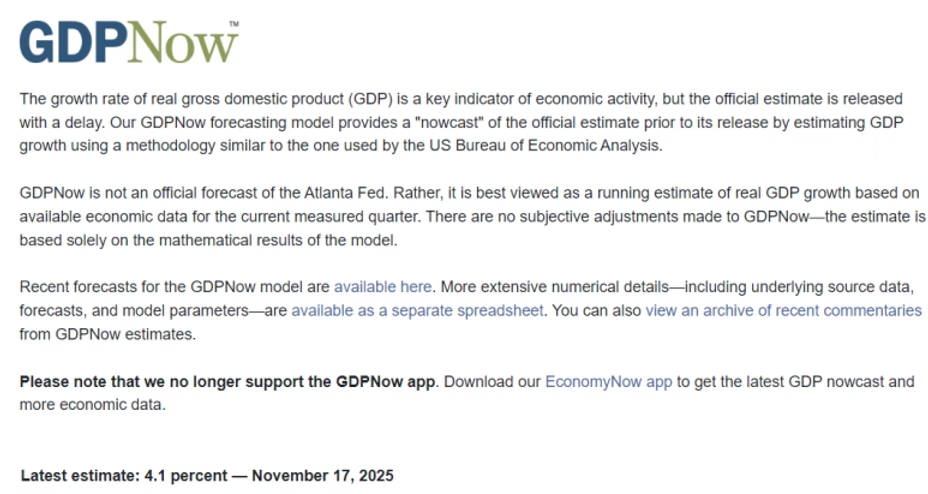
<GDPnow>
In other words, with Main Street’s demand for cash surging while reserves fall, short-term funding markets freeze—triggering problems on Wall Street. Short-term rates spike, hedge funds face soaring financing costs, leveraged positions unwind, and risk assets tumble. What we are witnessing is the conflict between Main Street’s acceleration and Wall Street’s liquidity constraints. It is a paradoxical situation where stronger real-economy growth sucks liquidity out of financial markets. And as financial assets drop, U.S. consumption weakens, hurting employment and growth in turn. The U.S. government can no longer focus on the real economy alone—financial stability now matters just as much.
The cause of the decline becomes the cause of the rebound.

So how does this get resolved? Liquidity is both the alpha and omega of the solution.
The first tool the government could consider is quantitative easing. The Fed would buy Treasuries and push reserves back into the system to restore liquidity to Wall Street. Politically and inflation-wise, however, the Fed is reluctant to use the word “QE.” Instead, multiple Fed officials have floated the idea of a “QE-lite”—a technical, limited asset-purchase program. Though they describe it as different from traditional QE, it still injects liquidity that stabilizes markets.
The second option is regulatory relief. The best example is SLR relaxation, which allows banks to hold more T-bills, easing funding pressure in the Treasury bill market. This was one of the key tools that helped stabilize markets during the 2020 pandemic.
And now, a third form of liquidity—something unprecedented—is being considered. That is the stablecoin system.
Why are stablecoins so important?
Stablecoins are not just digital tokens. They are a private-sector mechanism for expanding the dollar supply, backed by U.S. Treasury bills. This creates a previously nonexistent dual-channel liquidity engine.
As stablecoins are issued, T-bills are purchased. As T-bills are purchased, the government’s fiscal capacity expands. And this newly created fiscal space flows directly into the real economy. At the same time, stablecoins circulate into crypto markets, derivatives, ETFs, and DeFi—expanding leverage and liquidity inside Wall Street as well.
In other words, a single liquidity expansion event now boosts both the real economy and financial markets simultaneously. In the past, injecting 100 units of liquidity was the norm. But with stablecoins, the system effectively injects 200. This is the hidden engine that will allow the U.S. to fund its massive AI, defense, power infrastructure, and semiconductor investment cycle.
Which assets benefit most—and why?
Ethereum (ETH)Over 73% of all stablecoins are issued on Ethereum or ETH Layer-2 networks. RWA tokenization, data-center collateralization, and global digital-dollar on-ramps all operate on the Ethereum ecosystem. Once U.S. institutions formally adopt stablecoins, ETH effectively becomes the “digital infrastructure asset of the U.S. dollar.”
U.S. tech equities, centered around AI infrastructure, semiconductors, and data centers.Stablecoin-driven T-bill demand expands fiscal capacity, which ensures the continuity of state-backed AI infrastructure spending.
On-chain RWA markets—real estate, bonds, commodities.Beginning 2026, this market will expand massively. When global capital enters the U.S. through stablecoins, liquidity from EM, Europe, and the Middle East is absorbed into U.S. financial markets, reinforcing the cycle.
When does this stablecoin liquidity actually hit the market?
The recently approved GENIUS Act was signed on July 18, 2025. It becomes effective under two conditions:
120 days after final regulations are published, or
Automatically after 18 months, even if regulators publish nothing.
So far, Treasury has only issued the ANPRM, not the final rules. Thus the 18-month clause is most likely. That gives us January 18, 2027 as the formal activation date.
But markets will move earlier.NPRM releases, bank preparation, issuer preparation, and accelerated global T-bill purchases will begin in early 2026. Real liquidity expansion should start around Q3 2026, ramping into 2027. The “explosion phase” of stablecoin-driven liquidity will likely be priced in as early as mid-2026.
What must we do now?
We must look beyond daily numbers and focus on the structural transformation underway. The heart of the story is U.S.–China geopolitical competition, and at the center of that competition is liquidity. QE alone cannot solve this because real-economy growth is too strong. For Wall Street to withstand Main Street’s growth pace, reserves must rise and short-term funding markets must stabilize. Stablecoins are the key.
Therefore, our task is to understand this structural shift and position ahead of the 2026–2028 liquidity cycle. ETH and the broader Ethereum ecosystem, data-center/semiconductor/AI infrastructure assets, and the on-chain RWA sector form the core asset buckets. The current decline is merely a shock caused by short-term liquidity stress. The “double-liquidity era” that begins after 2026 will become the most powerful tailwind for these assets.


댓글